
Homecomings are always meaningful. Some are ancient, even Biblical. It is the theme of modern films and music, depicting the draw we all have and feel towards home. Until this week, I was caught up in my own attempts to come home, stranded in the United States amid the unfolding war against the Islamic Republic of Iran. My trip started surpassing one million miles on United, and ended after six canceled and changed flights, finally arriving home, one of hundreds of thousands doing so amid the war.
Historic parallels are uncanny—and profoundly Jewish. Amid countless miracles the Israelites complained throughout the Exodus from Egypt. Dorothy overcame hurdles along the Yellow Brick Road to Oz, and eventually back to Kansas. And today, fellow Israelis are grumbling through cancelled flights, rerouted journeys, and, in a twist only God could script, detours through Egypt to reach the Promised Land once more amid different challenges. This is double relevant at the season when we celebrate the Exodus and our redemption 3500 years ago, many have contemporary stories of finding their way back to the Land of Israel.
Then, fresh out of Egypt, the Children of Israel didn’t break into a victory song and march straight to Judea. They complained. Repeatedly. They chided Moses: “Was it for lack of graves in Egypt that you brought us to die in the wilderness?” (Exodus 14:11). When hunger hit, material nostalgia kicked in: “If only we had died by the Lord’s hand in Egypt! There we sat around pots of meat and ate all the food we wanted” (Exodus 16:3). Manna rained down, water burst from stone, yet the desert felt endless. Forty years of wandering wasn’t just geography; it was a spiritual forge. The people had to learn that freedom isn’t easy, and home isn’t reached without tests of faith and endurance. One can imagine the Children of Israel in the back of a minivan whining, “Are we there yet?”
Dorothy’s Yellow Brick Road feels like a modern take on the same theme. Ripped from Kansas by a tornado, she just wants to go home. She encounters a brainless Scarecrow, a heartless Tin Man, and a cowardly Lion. Neither the Wicked Witch, flying monkeys, poppy fields that knock you out, or a Wizard who’s all smoke and mirrors deters her. The complaints are quieter than the Israelites’, but the longing is the same. “There’s no place like home.” It’s a children’s story, yet it captures the Jewish soul. We wander, we face trials, but our home, the Land of Israel, is the fixed point that pulls us back.
Fast-forward to February 28, 2026. Operations Roaring Lion and Epic Fury launch, a bold, joint Israeli and American strike to dismantle Iran’s terror infrastructure and remove an existential threat. Immediately, Israeli airspace closes. Ben-Gurion Airport grinds to a halt. Foreign airlines cancel flights for weeks, then months. El Al slashes flights to a skeleton schedule. Hundreds of thousands of Israelis overseas – tourists, businesspeople, students – find themselves stranded awaiting rescue flights as modern day Wings of Eagles.
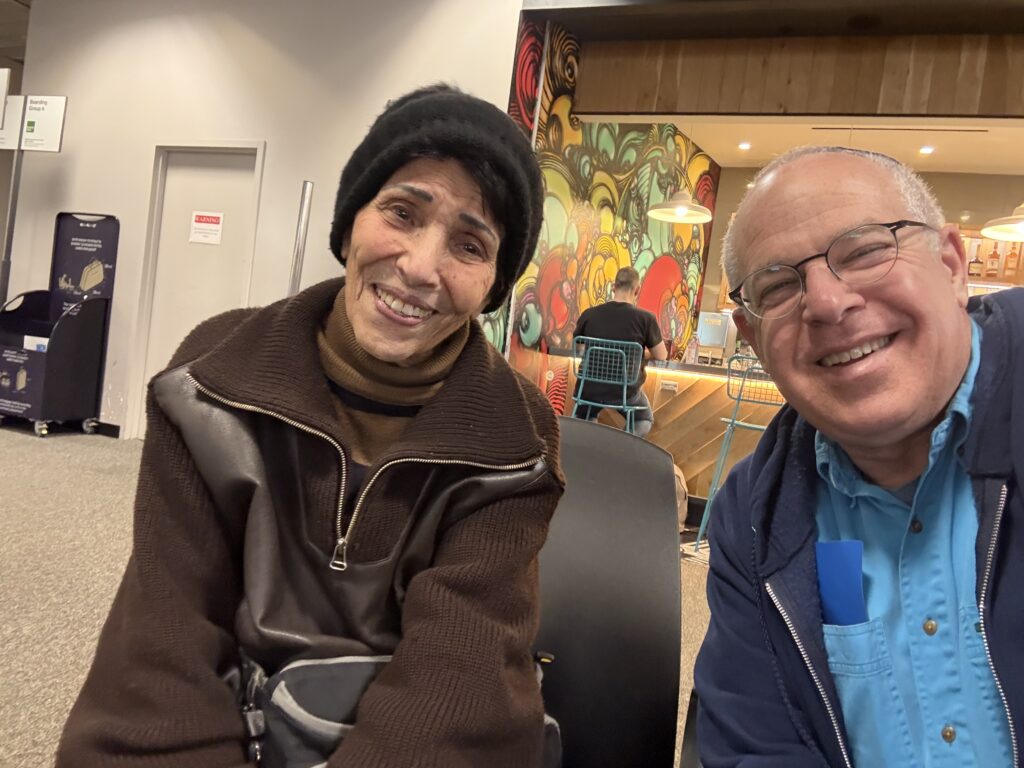
I meet Malka at the airport, who recounted her own exodus story from Yemen as a 6-year-old, traveling across land and by boat in 1943, before the modern “Operation Eagles Wings” that would rescue some 50,000 Jews from Yemen.
The rescue operation, ironically bringing people home, into a war zone rather than the opposite, is pure improvisation under fire. Domestic Israeli airlines organize special flights from European cities. Initially these are via Egyptian airports, then across Sinai. Passengers cross by land into Israel. Social media fills with stories of exhausted families dragging suitcases onto buses in European capitals, Jewish women being singled out for harassment in Egypt by the descendants of people who enslaved us, arriving to the very country from which our ancestors fled in the Exodus. One friend texted me: “We’re flying into Egypt to get home to Israel. Only in 2026.” The irony is intense. Sinai, once a place of manna and miracles, has become the transit point for Jews returning to Israel again. Even Joseph could not have dreamed this one.
Modern complaints echo biblical ones. “We went on vacation and came back as refugees.” Parents with toddlers describe sleepless nights in foreign terminals, mounting hotel bills. Repeated and seemingly unexplainable cancelations of flights. Some voice the darker Exodus refrain: Maybe it’s safer to stay put until the skies clear. Yet resilience wins. Some direct flights in and out of Israel resume albeit on a limited schedule and with tight restrictions about the number of passengers. Will it take 40 years this time too? The nation that rose with a roaring lion refuses to leave its children scattered.
The common theme from the Exodus, to Oz, to today is similar: the longing for home, and the affirmation that it is worth every detour and challenge. Each faces obstacles that seem engineered to break them: desert thirst, wicked enchantments, closed airspace and cancelled flights. Yet each reveals the same truth. The ancient Israelites learned dependence on God, and still sees miracles before our eyes as we struggle to get home. We see citizens adapting, a people that turns crisis into covenant. Some are new immigrants whose return is prophetic.
Especially this season as we celebrate Passover and recall the Exodus as if we had personally lived through it, many of us are. We are also experiencing the plagues of those who worship false gods and seek to destroy us along with Western civilization. But, why then and today, do there need to be so many challenges? Can’t we just appreciate the homecoming without the hurdles? Maybe that’s another question not just for our Passover seders, but for eternity. Maybe the message is never take for granted what you have, the people you love, or the miracles before you.
As I sit in the Judean mountains with claps of thunder intermingled with “booms” overhead from Iranian missiles, I’m reminded times may change but often the story is the same. Whether it’s forty years in the wilderness, a Technicolor dream, or weeks of rerouted flights via Sinai, the trials expose our frailties—complaints, doubts, nostalgia for the known. But they also reveal our strengths: adaptability, community, resilience, and an unquenchable belief that home, however imperfect, is worth every step.
The journey tests us. Home redeems us. God’s eternal covenant protects us. And sometimes, the ruby slippers—or the Israeli passport—are all we need to click our heels and say, “There’s no place like HOME!”

Leave a Reply