
With three weeks left before Israel’s October 27 election, the undecided voter is not a footnote. The most recent episode of the “Inspiration from Zion” podcast explored issues motivating the undecided voter as the fourth in a monthly series. The final conversation with the undecided voters before the election will take place Sunday, October 11. While there are a range of political opinions represented, the panelists made the same point from different directions: the lists are locked, the slogans are thin, and a large share of the electorate still has not chosen. As much as any one party could become the king maker, the undecided voter could coronate that party.
An hour before hosting the conversation, I participated in my first automated poll in this election cycle. I was not asked who I would vote for. I was asked whether I supported Benjamin Netanyahu, then two follow-up questions. I was honest and said I did not know who I would vote for, but I am not sure that the automated pollster was programmed to accept my answer. Panelist Arnie Draiman argued that this is exactly how polls miss the story. The usual question is, if elections were held today, which party would you vote for? Undecided is rarely a real option, so people are pushed into a name. The published tables then look more settled than the country is. The overall sense from the panel and from people I talk to, is that there are more undecided voters than the surveys are showing. Some, even many, may not decide until the day of the election. And in a country where there is no early voting and no absentee ballot, that last minute (impulsive) decision may make all the difference.
Undecided voters’ calculations still in play are personal, not partisan reflexes. Batya Medad comes from the right of the political spectrum. She has one litmus test: victory. She treats the rounds of fighting since long before October 7 as one long war, papered over each time a ceasefire is declared, and everything is called fine. She does not think Netanyahu has been competent, because if he had been, she says, the war would have ended more than a decade ago. She is not afraid of a change of leader. She remembers the years after Ben-Gurion, when prime ministers came and went, and she thinks a public that has known only one dominant figure for more than a decade has been trained to fear anyone else. She will not sit it out. If no list offers a real plan for victory, she will take the least bad option.
Mark Simanowitz, who comes from the left, is hovering between two parties and expects to decide inside the polling station, which he thinks is what most Israelis actually do. Arnie has narrowed the field from four or five parties to about three, but he is not shopping for a party head. He wants people lower on the list of the party he’ll vote for that he would trust as a neighbor: a mensch, someone who will run an agenda honestly. In his view the leaders tend to come with backroom trades attached, and the attack ads tell more about the party airing them than about the target. Yehuda Poch is down to two parties and will likely also decide on the day. His complaint is that neither is saying much of anything.
That last point runs straight into the electoral threshold issue. To be elected for any seats in the Knesset, a party needs to receive at least 3.25% of the vote. One of Yehuda’s options is hovering in polls near the minimum needed to enter the Knesset. If the polls indicate a slip, he is unlikely to vote for it, because he does not want a wasted ballot. If both parties still look safe, the choice stays hard. If a few thousand people make the same calculation not voting for a party that might not pass the threshold, the potential outcome is self-fulfilling, and the party fails because the polls said it would fail. In this case the poll does not merely describe the outcome. It starts to decide it.
The same uncertainty hangs over who can form a government. It’s not only the head of the party with the most votes, according to current polls vying between Netanyahu and challenger Gadi Eisenkot. In 2021 the surprise outcome of Naftali Bennett becoming Prime Minister with only seven seats in a coalition with Yair Lapid could play itself out again. Yehuda posited that Yoaz Hendel and Yaron Zelekha’s Reservist Party could become kingmakers this time.
Why? Bennett, he said, was the swing last time and is now firmly in the anti-Netanyahu camp, so he is no longer that kind of kingmaker. The problem is that most polls do not even see Hendel’s Reservist party – which is neither in the pro or anti Netanyahu camp – making it to the Knesset, which brings the argument full circle: a potential pivot party cannot pivot if voters abandon it for fear of wasting a vote. Mark offered a different perspective on kingmaking. Itamar Ben-Gvir, he suggested, could withhold support from Netanyahu after being pushed aside, and might be petty enough to sit elsewhere if the posts suit him. A government can fail because someone is angry, not only because someone is courted.
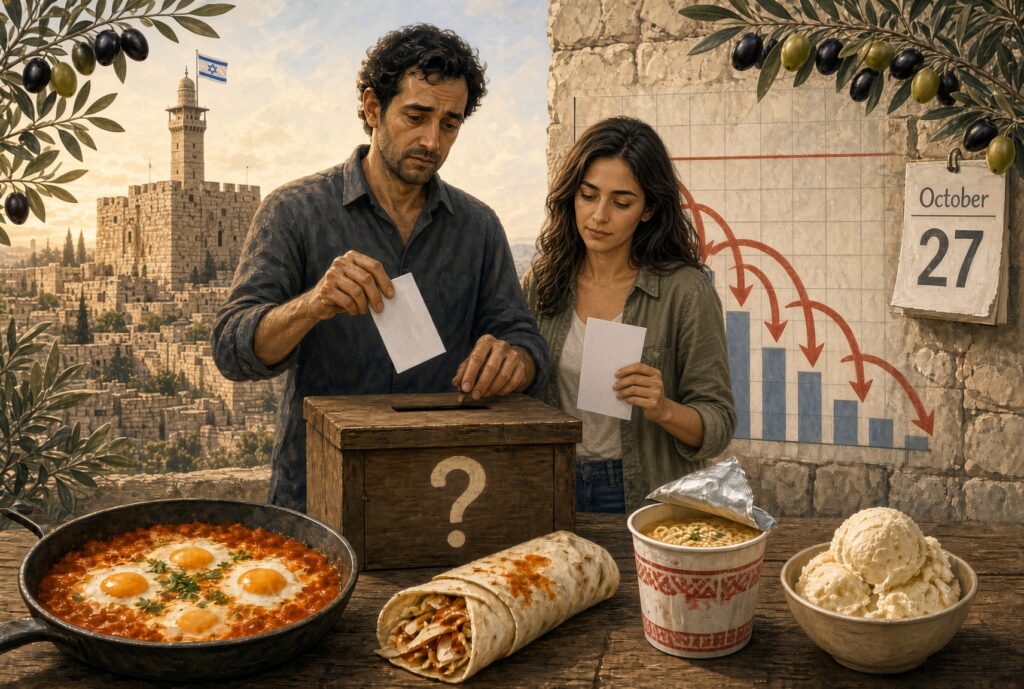
The panel closed on a lighter note, the way Israelis often close an argument they cannot yet settle, with food. What food does the election remind you of? Arnie called the campaign shakshuka: mixed, spicy, and better with bread and salad, a coalition of the shakshuka family. Mark chose instant noodle soup, easy and fun, then a little regrettable. Batya picked a parve (non-dairy) dessert, the kind where you are never quite sure what you are eating. Yehuda went with shawarma: plenty to sink your teeth into, add-ons you can choose or leave out, wrapped tightly enough to hold.
Like the election itself, the culinary selections set a gastronomic buffet, serving some options that repel us, some that are appealing, some you might want a taste of but not a full plate. Yet unlike the sumptuous buffet, the Israeli voter can only pick one. The shawarma comparison depicts the undecided vote with weeks to go particularly well. Still hot, made of chicken, turkey, beef or lamb, it’s being assembled by ingredient and topping, and nobody is sure yet what will be in the pita after October 27.
Register to join the fifth “What Are We Thinking” undecided voter panel, Sunday October 11 at 9:00pm Israel time (2:00pm Eastern in the US).
Leave a Reply